Are you ready for Agentic AI?
Find out in our 4-minute survey!
AS FEATURED AT SAS INNOVATE 2026 · HACKATHON SUPERDEMO
For more than twenty years, anti-money laundering has been the same puzzle. Billions of transactions move through financial systems every day, and only a tiny fraction of them are tied to actual financial crime. Finding those cases is a needle-in-a-haystack problem, and missing even one is out of the question.
Rule-based systems narrowed the search.
Machine learning shrank the haystack.
Neither changed the underlying game. Agentic AI does.
Aurora is a modular, agent-based suite built by Consortix on SAS Viya. It extends existing AML systems rather than replacing them, and it tackles the slowest, most manual parts of the scenario lifecycle while keeping every step transparent, documented, and auditable.
Scenario development traditionally runs through business requirements, IT specification, implementation, testing, tuning, approval, and go-live. Weeks of calendar time, many handovers, and plenty of room for things to get lost between business and IT.
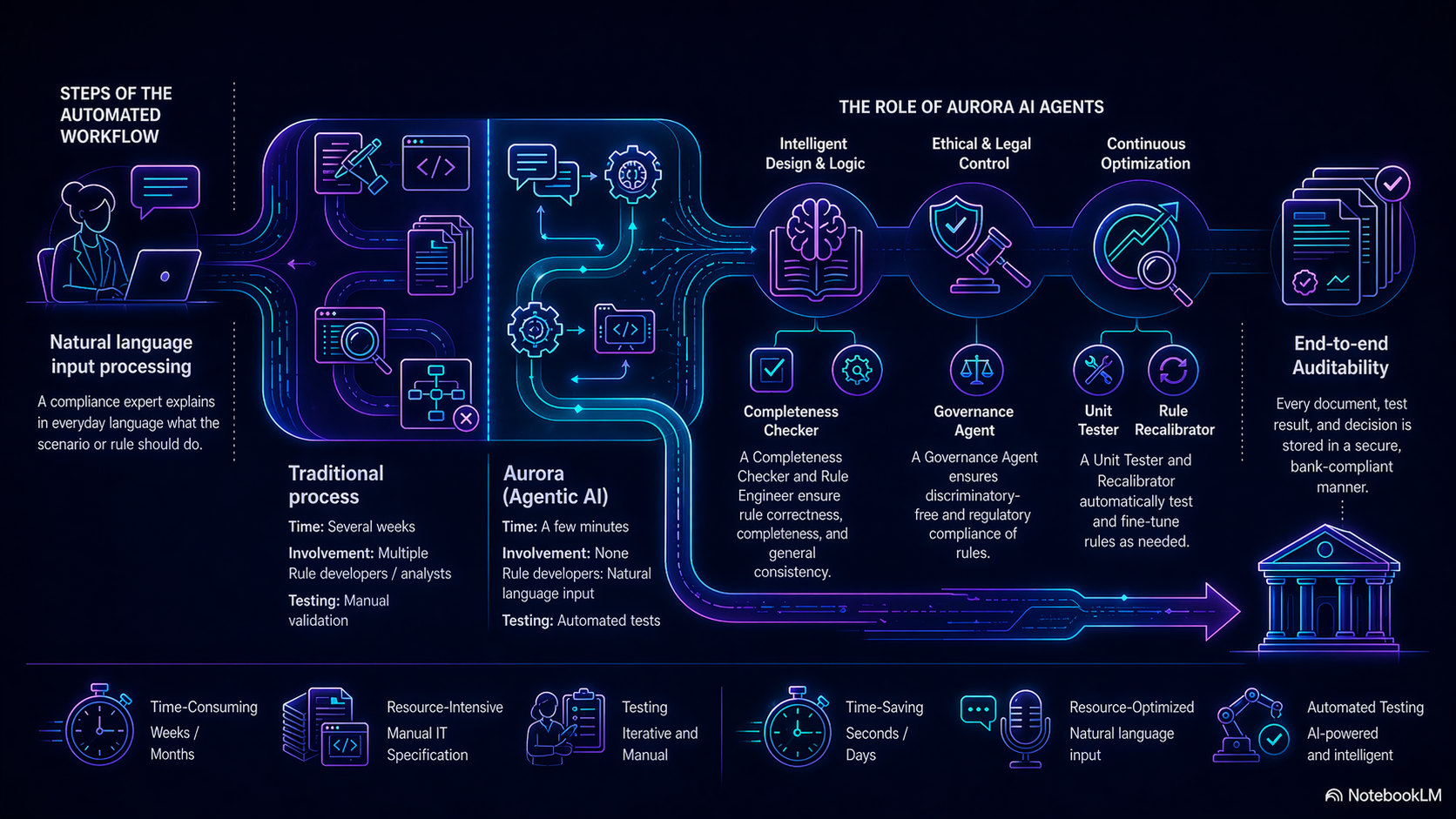
With Aurora, those same steps collapse into one directed workflow. The expert writes the requirement in natural language. The agents take over from there, turning it into a formal rule, testing it, validating compliance, and loading the result into production. What used to take weeks now takes days, and the scenario that comes out is documented, traceable, and always editable by the team responsible for it, so final control stays with the people who own the risk.
Today, a single new scenario takes two to six weeks and six to ten handoffs between compliance, business analysis, and IT before it reaches production, because every step from specification to implementation to testing runs through a manual translation chain.
Test data is built by hand, stays narrow, misses edge and boundary cases, and nobody has the capacity to map overlaps or run regression checks across hundreds of active scenarios.
Documentation falls out of sync with live configurations the moment someone skips the write-up, and version history lives in spreadsheets or in people's heads. Investigators spend two to four hours per medium-complexity alert collecting data from four to six disconnected systems and writing the case narrative from scratch, leaving little time for actual judgment.
SAR assembly repeats the same data-gathering problem after the investigation has already closed, with wording that varies by analyst and quality that depends on a single reviewer at the end of the chain.
The compliance expert describes a money-laundering pattern in plain language, without needing to know the target platform's configuration syntax. Aurora parses the description, extracts the logical conditions (transaction types, thresholds, time windows, entity relationships, risk weights), and returns its interpretation back in readable form for the expert to correct or approve. Once approved, Aurora creates the scenario configuration directly through the platform's API, removing IT's manual implementation step from the process entirely. The full cycle from typology description to production-ready scenario shrinks from weeks to hours, with mandatory testing and approval steps intact but waiting queues eliminated.
Aurora generates synthetic transaction data directly from the scenario logic: positive cases, negative cases, boundary cases at the threshold edge, and edge cases that deliberately fall short of the trigger. Each scenario gets its own unit-level test set that runs in isolation, and when a scenario changes, Aurora automatically reruns the test sets of every logically related scenario for regression coverage. Aurora also scans the full active scenario set to identify overlapping, redundant, or conflicting logic and returns a structured harmonization proposal with specific recommendations on what to merge, retire, or realign. All test data is privacy-clean because it is synthetic, and reproducible because Aurora regenerates it from the same specification on demand.
Aurora reads the live scenario configuration, interprets its logic, and produces a plain-language business description that mirrors what actually runs in the system. It runs on a schedule: periodic scans detect which configurations changed since the last run and update the affected documentation entries automatically. Each update records the prior state, the new state, and a timestamp, producing a structured change log as a by-product. Because Aurora links scenario logic back to the original natural-language description, the documentation preserves both the technical parameters and the business rationale (which typology the scenario answers and why it exists).
When an alert opens, Aurora pulls the relevant data from every connected source (transaction history, KYC profile, risk rating, screening status, account relationships, network links) and presents the analyst with an assembled picture instead of requiring them to hop between four to six systems. It interprets the gathered transaction set, identifying patterns that explain or strengthen the alert: unusual turnover intensity, counterparty identity, amount-rounding patterns, in-network money movement. Aurora then drafts the first case narrative with the basis of suspicion, supporting data points, and mitigating factors, turning what was a two-to-four-hour writing and collection exercise into a review-and-approve task. The final decision and sign-off stay with the analyst, as regulation requires.
At investigation close, Aurora assembles the SAR draft from the already-aggregated case data: entities, accounts, transactions, period of activity, applied typology, and suspicion narrative, all in the structure and terminology the receiving FIU expects. Every SAR comes out in the same format and level of detail regardless of which analyst investigated the case, which cuts the return and supplement risk that manual wording inconsistency used to cause. The Aurora agent loads the approved report directly into the FIU submission system or the internal case platform without manual re-entry. The analyst's role shifts from assembly to validation, and the time gained works directly against the statutory filing deadline.
Discover the capabilities and real business benefits in detail.
The pipeline is modular: each agent performs one auditable task and hands a structured artifact to the next.
Translates the confirmed description into formal,system-readable rule logic. The output is technically implementable, fully documented, and structuredfor audit.
Reads the natural-language description and verifies that all the information required to build the rule is present. If something is missing or ambiguous,it asks targeted questions and records the clarified input.
Checks whether the new rule overlaps with existing scenarios and verifies that the rule contains no discriminatory or legally impermissible filtering conditions. Regulatory and ethical compliance is enforced at the point of creation.
Generates test cases automatically, runs them against the proposed rule, and produces a pass/fail report. Where test results suggest refinement, it feeds observations back into the logic.
Updates the AI models already in production with fresh data produced by the new rule, keeping the broader detection system aligned with the latest logic.
Most compliance teams know AI is coming. Few know how ready they actually are. Answer a few questions and we'll send you your readiness score, how you compare to peers in financial crime, and where Aurora can help you move forward.
At the 2025 SAS Hackathon, a global competition with over 2,000 participants from 66 countries, the Consortix-AURORA team won three categories: Banking, Agentic AI/Decisioning, and Trustworthy AI. The Banking win recognized Aurora's approach to AML scenario development. The other two awards reflected that automation speed and regulatory governance can coexist in the same solution. The overall champion will be announced at SAS Innovate 2026 in April, where Consortix is among the contenders.