From Weeks to Days: How Aurora Is Changing AML Scenario Development
Building a new anti-money laundering detection rule has always been slow. A compliance team identifies a risk pattern, writes a business requirement, hands it off to IT for specification, waits for implementation, runs tests, and iterates on fine-tuning before the rule goes live. The cycle routinely takes weeks, sometimes months. Aurora, developed by Consortix on the SAS Viya platform, compresses it to days.
At the 2025 SAS Hackathon, a global competition with over 2,000 participants from 66 countries, the Consortix-AURORA team won three categories: Banking, Agentic AI/Decisioning, and Trustworthy AI. The Banking win recognized Aurora's approach to AML scenario development; the other two awards reflected that automation speed and regulatory governance can coexist in the same solution. The overall champion will be announced at SAS Innovate 2026 in April, where Consortix is among the contenders.
The Bottleneck in AML Scenario Development
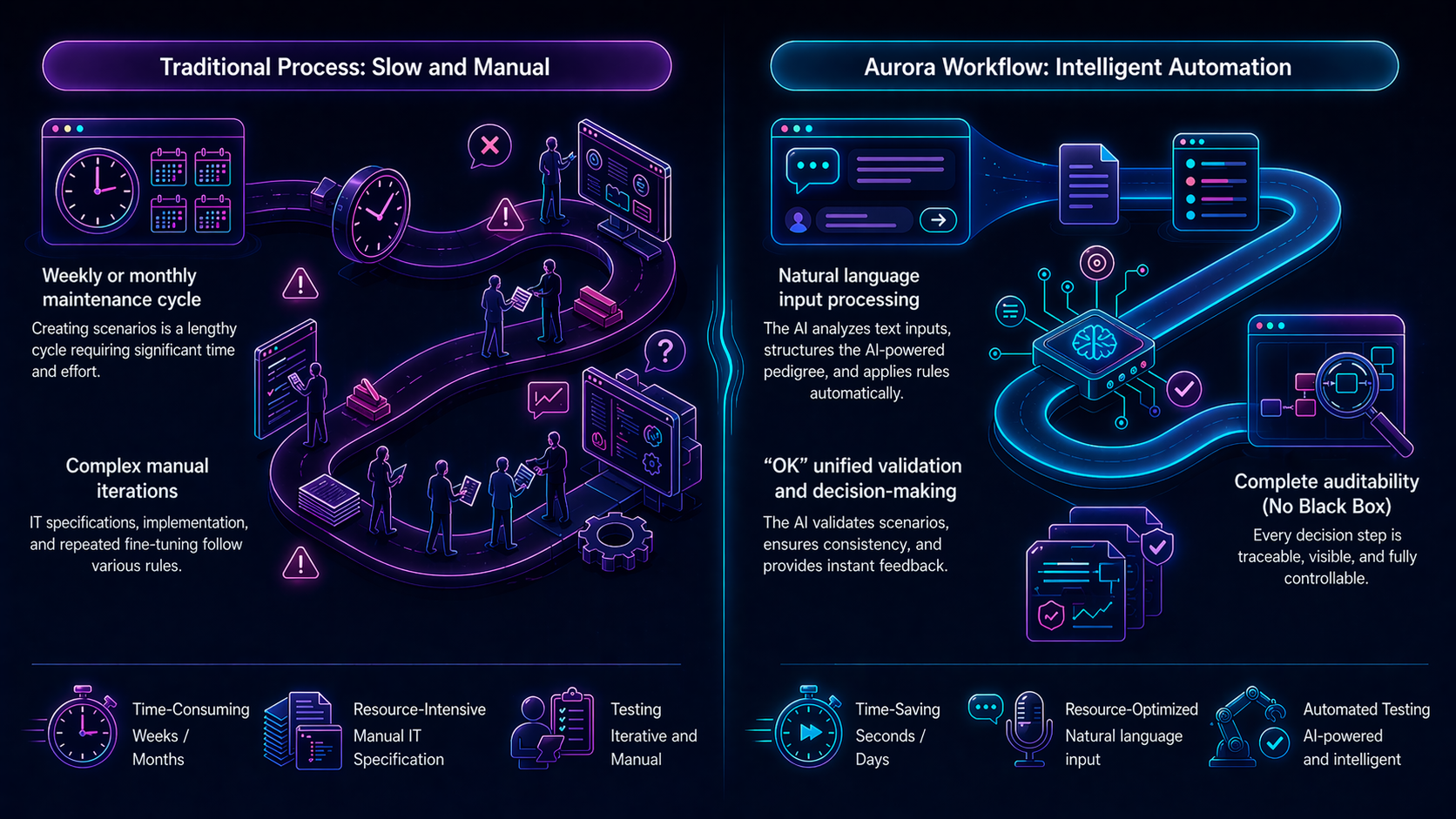
Banking compliance teams know the cycle well. A new detection rule means writing a business requirement, waiting for an IT specification, implementing the scenario, running tests, fine-tuning, and getting sign-off before anything goes live. From start to finish, the process typically takes weeks — sometimes months — and requires extensive coordination at every handoff.
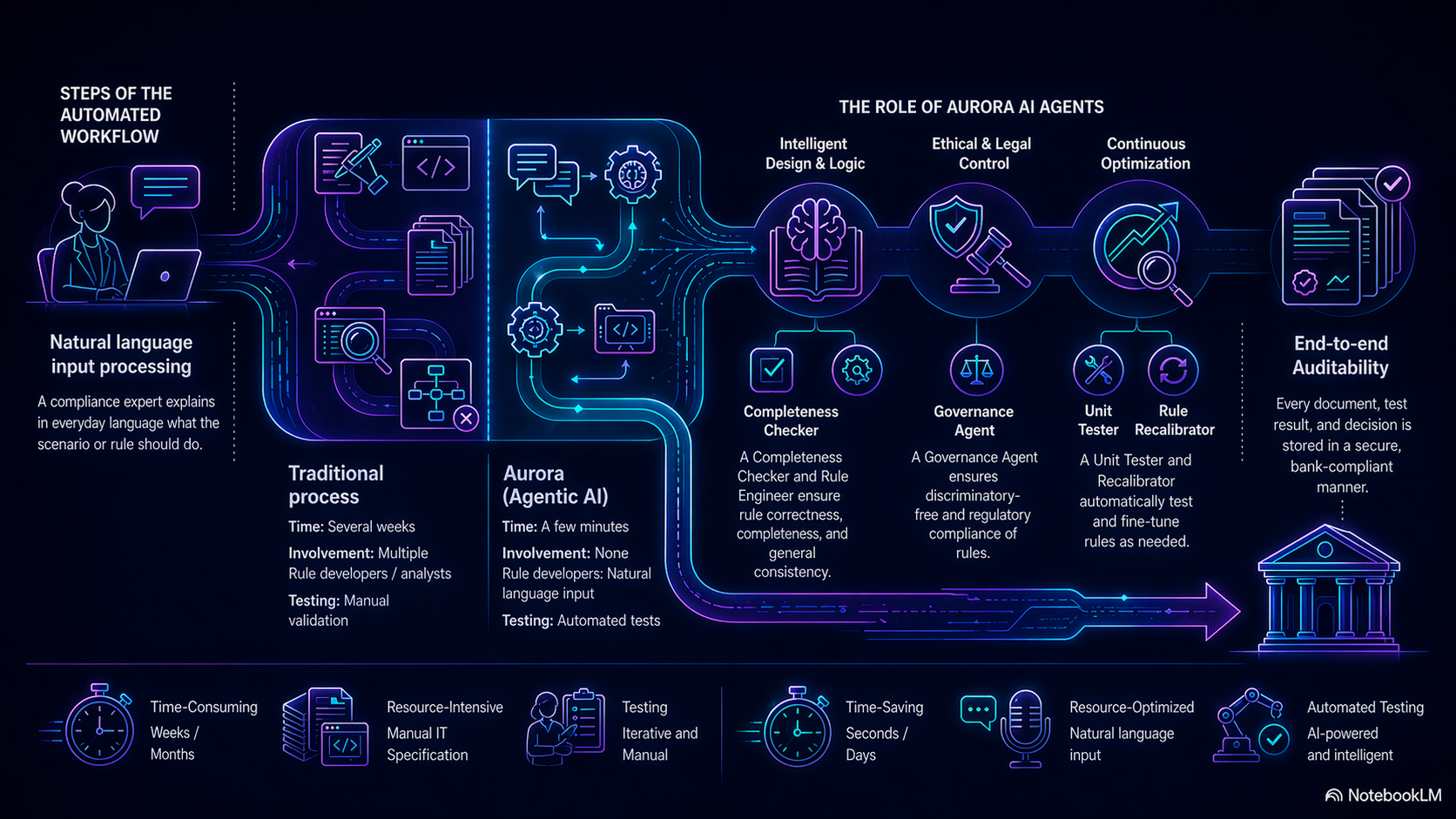
Aurora, developed by Consortix on the SAS Viya platform, replaces that cycle with a single guided workflow. A compliance expert describes the requirement in plain language ("flag offshore transactions above €10,000"), and a set of AI agents handles the rest.
How the agents work
The Completeness Checker reviews the description first and, where information is missing or ambiguous, asks targeted questions before any technical work begins. The Rule Engineer translates the requirement into a formal, machine-readable definition, documented and fully auditable. The Governance Agent checks for overlap with existing rules and screens for regulatory and ethical issues, including discriminatory filtering conditions. The Unit Tester generates and runs test cases automatically, then refines the rule based on the results. The Recalibrator enriches the existing AI models with the new data. Once everything clears, Aurora loads the scenario directly into the system.
The full process from the initial description through completeness checks, governance review, testing, model recalibration, and deployment, is documented and auditable at every step. The scenario can be modified at any time and is fully transparent. Every decision remains traceable, and the compliance expert retains control throughout.
What AML workflows can actually be automated with AI today?
It helps to put the two approaches side by side. In the traditional process, a business requirement is written, passed to IT for specification, implemented as a scenario, tested, fine-tuned, and then approved and pushed live. Each stage is a separate handoff, and the accumulated coordination time is where weeks turn into months.
With Aurora, the compliance expert writes the requirement once, in plain language. The system structures it into a formal rule, checks for completeness and asks follow-up questions where needed, runs tests, validates regulatory compliance, screens for overlaps with existing rules, fine-tunes the scenario and the underlying models, and loads it into the system. Each of those steps that previously crossed organizational boundaries now happens within a single workflow.
Aurora is faster, but the more significant claim is that it reasons alongside the person writing the requirement. When a description is vague or incomplete, Aurora recognizes what is missing, asks for clarification or offers suggestions, and typically produces a more precise result than a brief that looked complete on first reading. The outcome is faster deployment, fewer iterations, and less miscommunication between business and IT.
Scenario creation time drops from weeks to days. Aurora integrates SAS Anti-Money Laundering, SAS Financial Crimes Analytics, and large language model capabilities on SAS Viya, turning agentic AI into a practical capability for AML operations today.
Interested in more like this?
Subscribe to our newsletter to get updates on AML technology and more financial crime related news.
By clicking “Accept All Cookies”, you agree to the storing of cookies on your device to enhance site navigation, analyze site usage and assist in our marketing efforts. More info
By clicking “Accept All Cookies”, you agree to the storing of cookies on your device to enhance site navigation, analyze site usage and assist in our marketing efforts. More info